Hardly anyone can live without extra income.
January 29, 2014 / Martina Zick - Stuttgarter Zeitung
Anyone who wants to earn a living as a musician must be prepared to play at corporate events.
By Martina Zick
Anyone who opens the events section of this newspaper will find a daily, extensive, and diverse range of cultural offerings. "Nowhere is the density of music as high as in Stuttgart and the surrounding area," says jazz musician Martin Keller, who is also chairman of the Jazz Interest Group (IG Jazz). But can musicians outside the classical music establishment actually make a living from their art? There are no figures on this, only the answer: "Yes, but." Anyone who wants to support themselves solely through their art and focus exclusively on performances is out of luck. This becomes clear in conversations with various people involved. Martin Keller: "Of course, no one can live off jazz alone." But he also says: "It's no walk in the park, but everyone gets by." Ultimately, there are two ways to have a reasonably secure source of income in addition to concerts: "You earn money with commercial music or you find a teaching position." "Income is always a mixed calculation," says Mini Schulz, professor of bass (jazz and pop) at the Stuttgart University of Music and Performing Arts. This applies to the entire spectrum from jazz to pop. For Peter James, head of the Stuttgart Pop Office, the question arises in the field of advertising: where does the line go? Who is a musician, and who is merely a service provider? Is it even possible to separate the two? In popular music, there is certainly a great deal of passion involved. For James, this definition applies "where the income isn't profitable." And only a few are profitable. One can give success a little boost by setting oneself apart from the mainstream. Moreover, the combination of playing in one's own band and teaching is also common in his field. For Branko Arnsek, there is no question that musicians shouldn't be too proud to offer services. Private parties, corporate events, and similar engagements are, for him, a matter of course.
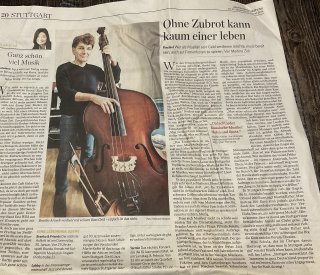
Arnsek knows how the business works: The Slovenian native, who grew up in Sindelfingen, studied at the Swiss Jazz School in Bern, and has lived in Stuttgart for decades, is firmly established in the local music scene. With his bands Tokame and the Guttenberger Brothers, he has carved out two niches: Cuban music with a European twist, and Gypsy Swing. The bassist also teaches at the music school, hosts his "Branko & Friends" series at the Arigato venue, and takes advantage of as many performance opportunities as possible, even outside of his band activities.
This, in turn, requires a strong network. Arnsek emphasizes that studying music is essential, if only for building connections. A musician needs to start early and never lose sight of these contacts. He has often reconnected with old acquaintances after many years, secured gigs through them, or helped them get gigs. "Musicians hire each other," Arnsek explains. But, he adds, "You have to be a fighter" to keep the complex system of colleagues, promoters, clients, and, of course, your own artistic vision running smoothly. Being his own manager and producer is also part of Arnsek's daily life. For example, recording CDs is essential for a musician, even though it's long been a losing proposition. But there's simply no way around it. "It's like making posters," says Arnsek. Anyone who slacks off in any of the many areas—in their own standards, in practice, in their stage presence—is quickly out of the game. This is all the more true given the significant increase in the number of bands, particularly in the service sector. This means it's become more difficult to get gigs. Moreover, the fees are "no longer nearly as generous as they used to be." In Stuttgart, the fees paid in jazz clubs range between 100 and 200 euros, says Martin Keller. However, at least 100 euros are guaranteed, thanks to the state jazz association: The association subsidizes concerts in the clubs. This is "a very good model." In addition, there is a considerable number of clubs in and around Stuttgart. "We're in a fantastic position and should be really proud of that," says Keller, citing the Bix, the Kiste, and the Forum Theater as important venues in Stuttgart. Mini Schulz, who is also convinced that one can make a "very good" living from music in Stuttgart, is equally full of praise: "Stuttgart provides the best proportional support for the jazz scene in all of Germany. The city's commitment is truly remarkable."